
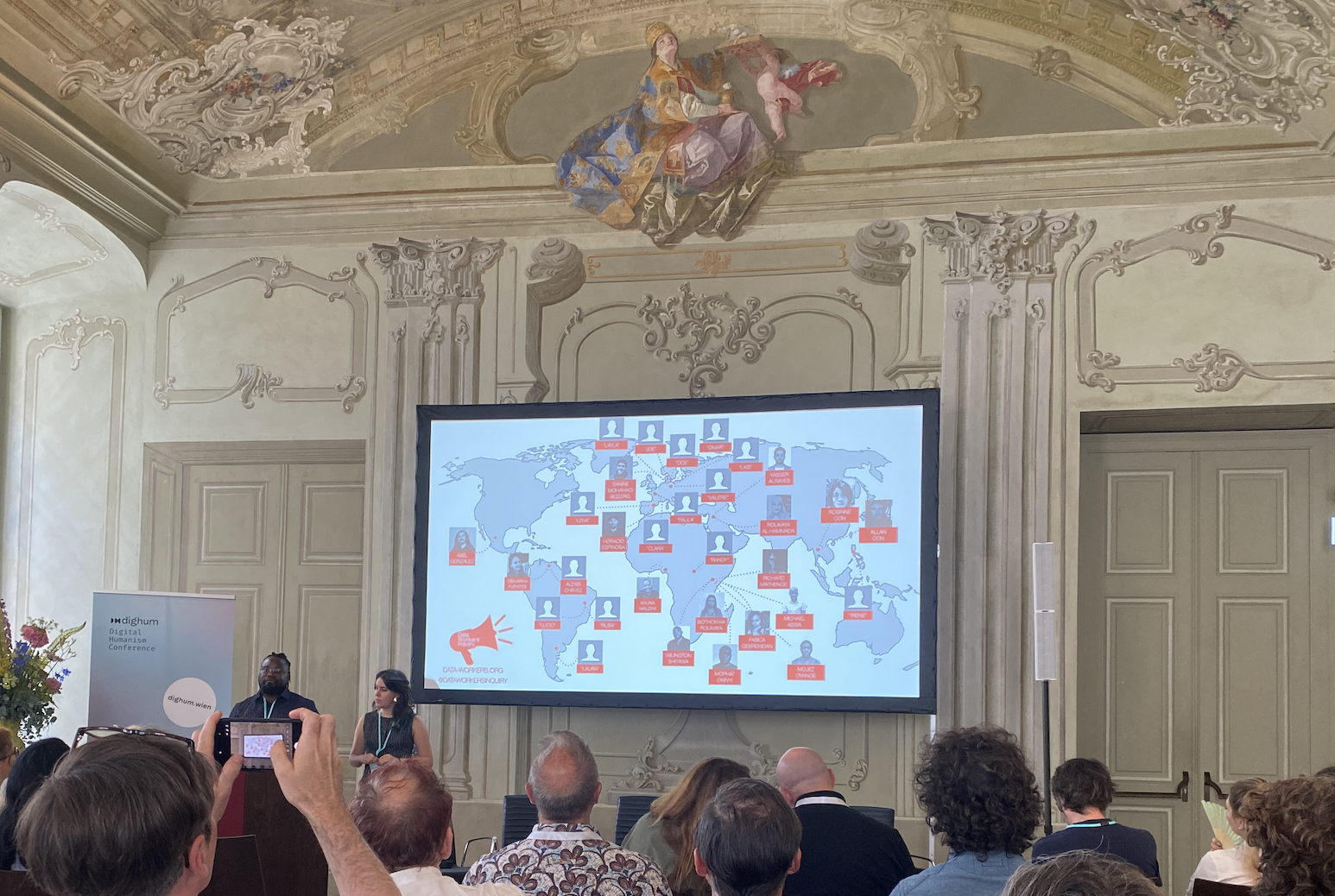
Pangea supports and contributes to the Digital Humanism Initiative. What is Digital Humanism?
Digital humanism is an ethics for the Digital Age. As an interdisciplinary field of study in action, it investigates the complex interplay between digital technology and humankind, and strives to make digital technologies align with human values and dignity. It combines perspectives from philosophy, computer science, humanities, law and the social sciences.[1][2][3].
Digital humanism is inspired by the Enlightenment and by classical humanism[4][5]. In line with these schools of thought, digital humanism regards the human being as the measure of all things. It therefore defends and reaffirms this principle, seeing digital technology and innovation not as an autonomous or inevitable force, but as a sociotechnical construct that can and must be shaped through ethical reflection, democratic deliberation, and collective societal action[7][8].
Digital Humanism emerged in response to the accelerated digital transformation through the widespread adoption of digital platforms, social media and Artificial Intelligence, and their impact on Society. As a field of study in action, digital humanism seeks, not only to understand digital transformation in Society, but also to guide it in a human-centric way, based on ethics and social principles[9][10][11]. As a design and action framework digital humanism provides and promotes models for ethical and value-driven technology design[12]. It promotes alignment of technological development with human rights, democracy and human well-being[13][14], while critically scrutinizing technocratic and purely market-driven approaches[15][16].
Digital humanism, as a normative framework, rejects both the mechanistic view that “human beings are machines” and the animistic view that “computers are like humans”[17]. It argues that digital systems should never be allowed to replace humans and their ethical judgement and responsibility in decision-making processes[18]. The field emphasizes human values, democracy, participation, inclusion, diversity and the protection of human rights and dignity through a bottom-up approach[19]. Central concepts within Digital Humanism include human agency, autonomy, responsibility, reason, and freedom[20].
References
- Werthner, Hannes; Ghezzi, Carlo; Kramer, Jeff; Nida-Rümelin, Julian; Nuseibeh, Bashar; Prem, Erich; Stanger, Allison (2024). Introduction to Digital Humanism – A Textbook (1st ed.). Switzerland: Springer Nature Switzerland AG. pp. v–x. doi:10.1007/978-3-031-45304-5. ISBN 978-3-031-45303-8.
- Ludger Hagedorn, Ute Schmid, Susan Winter, Stefan Woltran (20 November 2025). Digital Humanism. LNCS16319. Vol. 16319 (1st ed.). Switzerland: Springer Nature Switzerland AG. pp. v–vi. doi:10.1007/978-3-032-11108-1. ISBN 978-3-032-11107-4.
- Wyatt, Sally (2022), Werthner, Hannes; Prem, Erich; Lee, Edward A.; Ghezzi, Carlo (eds.), “Interdisciplinarity: Models and Values for Digital Humanism”, Perspectives on Digital Humanism, Cham: Springer International Publishing, pp. 329–334, doi:10.1007/978-3-030-86144-5_45, ISBN 978-3-030-86144-5, retrieved 2026-05-14
- Nida-Rümelin, Julian; Staudacher, Klaus (2024), Werthner, Hannes; Ghezzi, Carlo; Kramer, Jeff; Nida-Rümelin, Julian (eds.), “Philosophical Foundations of Digital Humanism”, Introduction to Digital Humanism, Cham: Springer Nature Switzerland, pp. 17–30, doi:10.1007/978-3-031-45304-5_2, ISBN 978-3-031-45303-8, retrieved 2026-05-14
- Coeckelbergh, Mark (2024-03-01). “What is digital humanism? A conceptual analysis and an argument for a more critical and political digital (post)humanism”. Journal of Responsible Technology. 17 100073. doi:10.1016/j.jrt.2023.100073. ISSN 2666-6596.
- Nida-Rümelin, Julian; Winter, Dorothea (2024), Werthner, Hannes; Ghezzi, Carlo; Kramer, Jeff; Nida-Rümelin, Julian (eds.), “Humanism and Enlightenment”, Introduction to Digital Humanism: A Textbook, Cham: Springer Nature Switzerland, pp. 3–16, doi:10.1007/978-3-031-45304-5_1, ISBN 978-3-031-45304-5, retrieved 2026-05-14
- Werthner, Hannes (2025). Digital humanism: on digitalization and artificial intelligence. Cham: Springer. ISBN 978-3-031-86904-4.
- Akkermans, Hans; Gordijn, Jaap; Bon, Anna (2022), Werthner, Hannes; Prem, Erich; Lee, Edward A.; Ghezzi, Carlo (eds.), “Return to Freedom: Governance of Fair Innovation Ecosystems”, Perspectives on Digital Humanism, Cham: Springer International Publishing, pp. 53–60, doi:10.1007/978-3-030-86144-5_8, ISBN 978-3-030-86143-8, retrieved 2026-05-14
- Pettinari, Sara; De Sanctis, Martina; Inverardi, Paola (2026). “Realizing Ethical-Aware Business Processes”. In Hagedorn, Ludger; Schmid, Ute; Winter, Susan; Woltran, Stefan (eds.). Digital Humanism. Lecture Notes in Computer Science. Vol. 16319. Cham: Springer Nature Switzerland. pp. 219–235. doi:10.1007/978-3-032-11108-1_16. ISBN 978-3-032-11108-1.
- Werthner, Hannes (2024), Werthner, Hannes; Ghezzi, Carlo; Kramer, Jeff; Nida-Rümelin, Julian (eds.), “Digital Transformation, Digital Humanism: What Needs to Be Done”, Introduction to Digital Humanism: A Textbook, Cham: Springer Nature Switzerland, pp. 115–132, doi:10.1007/978-3-031-45304-5_8, ISBN 978-3-031-45304-5, retrieved 2026-05-14
- Inverardi, Paola (2022), Werthner, Hannes; Prem, Erich; Lee, Edward A.; Ghezzi, Carlo (eds.), “The Challenge of Human Dignity in the Era of Autonomous Systems”, Perspectives on Digital Humanism, Cham: Springer International Publishing, pp. 25–29, doi:10.1007/978-3-030-86144-5_4, ISBN 978-3-030-86144-5, retrieved 2026-05-14
- Prem, Erich; Neidhardt, Julia; Knees, Peter; Woltran, Stefan; Werthner, Hannes (2023-09-19), Vrijenhoek, Sanne; Michiels, Lien; Kruse, Johannes; Starke, Alain (eds.), Digital Humanism and Norms in Recommender Systems, TU Wien, TU Wien, doi:10.34726/8560, retrieved 2026-05-14
- Metakides, George (2024), Werthner, Hannes; Ghezzi, Carlo; Kramer, Jeff; Nida-Rümelin, Julian (eds.), “Democracy in the Digital Era”, Introduction to Digital Humanism: A Textbook, Cham: Springer Nature Switzerland, pp. 495–509, doi:10.1007/978-3-031-45304-5_31, ISBN 978-3-031-45304-5, retrieved 2026-05-14
- Prem, Erich (2024), Werthner, Hannes; Ghezzi, Carlo; Kramer, Jeff; Nida-Rümelin, Julian (eds.), “Approaches to Ethical AI”, Introduction to Digital Humanism: A Textbook, Cham: Springer Nature Switzerland, pp. 225–239, doi:10.1007/978-3-031-45304-5_15, ISBN 978-3-031-45304-5, retrieved 2026-05-14
- Nowotny, Helga (2022), Werthner, Hannes; Prem, Erich; Lee, Edward A.; Ghezzi, Carlo (eds.), “Digital Humanism: Navigating the Tensions Ahead”, Perspectives on Digital Humanism, Cham: Springer International Publishing, pp. 317–321, doi:10.1007/978-3-030-86144-5_43, ISBN 978-3-030-86144-5, retrieved 2026-05-14
- Díaz de la Cruz, Cristina; Fernández Fernández, José Luis; Villegas-Galaviz, Carolina (2025-10-01). “Model of ethical analysis of digital technologies: towards true digital humanism”. AI & Society. 40 (7): 5743–5754. doi:10.1007/s00146-025-02330-w. ISSN 1435-5655.
- Nida-Rümelin, Julian; Staudacher, Klaus (2024), Werthner, Hannes; Ghezzi, Carlo; Kramer, Jeff; Nida-Rümelin, Julian (eds.), “Philosophical Foundations of Digital Humanism”, Introduction to Digital Humanism: A Textbook, Cham: Springer Nature Switzerland, pp. 17–30, doi:10.1007/978-3-031-45304-5_2, ISBN 978-3-031-45304-5, retrieved 2026-04-20
- Österle, Hubert (2022), Werthner, Hannes; Prem, Erich; Lee, Edward A.; Ghezzi, Carlo (eds.), “Ethics or Quality of Life?”, Perspectives on Digital Humanism, Cham: Springer International Publishing, pp. 263–269, doi:10.1007/978-3-030-86144-5_35, ISBN 978-3-030-86144-5, retrieved 2026-05-14
- Serrano, Gemma; Striano, Francesco; Umbrello, Steven (2024-06-01). “Digital humanism as a bottom-up ethics”. Journal of Responsible Technology. 18 100082. doi:10.1016/j.jrt.2024.100082. ISSN 2666-6596.
- Nowotny, Helga (2024), Werthner, Hannes; Ghezzi, Carlo; Kramer, Jeff; Nida-Rümelin, Julian (eds.), “The Re-enchanted Universe of AI: The Place for Human Agency”, Introduction to Digital Humanism: A Textbook, Cham: Springer Nature Switzerland, pp. 197–209, doi:10.1007/978-3-031-45304-5_13, ISBN 978-3-031-45304-5, retrieved 2026-04-20
- Prem, Erich (2024-03-01). “Principles of digital humanism: A critical post-humanist view”. Journal of Responsible Technology. 17 100075. doi:10.1016/j.jrt.2024.100075. ISSN 2666-6596.
- Elbanna, Amany; Carlsson, Linnéa (2026). “Digital Humanism in IS Research: A Research Agenda for a New Movement to Re-center the Human”. In Elbanna, Amany; Janssen, Marijn; Dwivedi, Yogesh K.; Hossain, Mohammad; Islind, Anna Sigridur (eds.). Digital Adoption, Diffusion and Innovation in the Augmented and Digital Society. IFIP Advances in Information and Communication Technology. Vol. 779. Cham: Springer Nature Switzerland. pp. 117–129. doi:10.1007/978-3-032-16779-8_8. ISBN 978-3-032-16779-8.
- Nida-Rümelin, Julian. Digital humanism: For a humane transformation of democracy, economy and culture in the digital age (p. 127). Springer Nature.
- “LAELIUS DE AMICITIA:”, Cicero: Laelius on Friendship and The Dream of Scipio, Liverpool University Press, pp. 75–118, 1990-01-15, ISBN 978-1-83553-938-5, retrieved 2026-05-17
- Doueihi, Milad (2011). “Pour un humanisme numérique”. Communication & Languages. 167 (1): 3–15. doi:10.4074/S033615001101101X.
- Pezzano, Giacomo (2024-03-01). “Are we done with (Wordy) manifestos? Towards an introverted digital humanism”. Journal of Responsible Technology. 17 100078. doi:10.1016/j.jrt.2024.100078. ISSN 2666-6596.
- Werthner, Hanns; Prem, Erich; Lee, Edward A.; Ghezzi, Carlo (2022). Perspectives on Digital Humanism (1st ed.). Switzerland: Springer Cham. pp. v–ix. ISBN 978-3-030-86143-8.
- Schiaffonati, Viola (2024), Werthner, Hannes; Ghezzi, Carlo; Kramer, Jeff; Nida-Rümelin, Julian (eds.), “Promises and Perils in Moralizing Technologies”, Introduction to Digital Humanism, Cham: Springer Nature Switzerland, pp. 255–265, doi:10.1007/978-3-031-45304-5_17, ISBN 978-3-031-45303-8, retrieved 2026-05-14
- Prem, Erich (2024), Werthner, Hannes; Ghezzi, Carlo; Kramer, Jeff; Nida-Rümelin, Julian (eds.), “Approaches to Ethical AI”, Introduction to Digital Humanism: A Textbook, Cham: Springer Nature Switzerland, pp. 225–239, doi:10.1007/978-3-031-45304-5_15, ISBN 978-3-031-45304-5, retrieved 2026-05-14
- Schmid, Ute (2024), Werthner, Hannes; Ghezzi, Carlo; Kramer, Jeff; Nida-Rümelin, Julian (eds.), “Trustworthy Artificial Intelligence: Comprehensible, Transparent and Correctable”, Introduction to Digital Humanism: A Textbook, Cham: Springer Nature Switzerland, pp. 151–164, doi:10.1007/978-3-031-45304-5_10, ISBN 978-3-031-45304-5, retrieved 2026-05-14
- Talia, Domenico (2026). “Privacy Merchants and Data Protection in the Age of Big Data and Artificial Intelligence”. In Hagedorn, Ludger; Schmid, Ute; Winter, Susan; Woltran, Stefan (eds.). Digital Humanism. Lecture Notes in Computer Science. Vol. 16319. Cham: Springer Nature Switzerland. pp. 390–403. doi:10.1007/978-3-032-11108-1_30. ISBN 978-3-032-11108-1.
- Lindorfer, Martina (2024), Werthner, Hannes; Ghezzi, Carlo; Kramer, Jeff; Nida-Rümelin, Julian (eds.), “The Threat of Surveillance and the Need for Privacy Protections”, Introduction to Digital Humanism, Cham: Springer Nature Switzerland, pp. 593–609, doi:10.1007/978-3-031-45304-5_37, ISBN 978-3-031-45303-8, retrieved 2026-05-14
- Parker, Geoffrey; Van Alstyne, Marshall (2024), Werthner, Hannes; Ghezzi, Carlo; Kramer, Jeff; Nida-Rümelin, Julian (eds.), “Platforms: Their Structure, Benefits, and Challenges”, Introduction to Digital Humanism, Cham: Springer Nature Switzerland, pp. 523–542, doi:10.1007/978-3-031-45304-5_33, ISBN 978-3-031-45303-8, retrieved 2026-05-14
- Neppel, Clara; Shaw, Patricia (2024), Werthner, Hannes; Ghezzi, Carlo; Kramer, Jeff; Nida-Rümelin, Julian (eds.), “Governance for Digital Humanism: The Role of Regulation, Standardization, and Certification”, Introduction to Digital Humanism, Cham: Springer Nature Switzerland, pp. 317–338, doi:10.1007/978-3-031-45304-5_21, ISBN 978-3-031-45303-8, retrieved 2026-05-14
- Müller, Martin; Kettemann, Matthias C. (2024), Werthner, Hannes; Ghezzi, Carlo; Kramer, Jeff; Nida-Rümelin, Julian (eds.), “European Approaches to the Regulation of Digital Technologies”, Introduction to Digital Humanism, Cham: Springer Nature Switzerland, pp. 623–637, doi:10.1007/978-3-031-45304-5_39, ISBN 978-3-031-45303-8, retrieved 2026-05-14
Leave a Reply